PI Controls Europe Breather Valves (Pressure / Vacuum Relief)
Gulf Oil & Gas International specializes in precision engineering, application-specific customization, and supply of genuine PI Controls Europe Breather Valves. Designed to safeguard atmospheric and low-pressure storage tanks, process vessels, and solvent storage systems from excessive overpressure rupture and devastating vacuum implosion, our valves conserve evaporation losses, contain volatile toxic vapors, and ensure comprehensive fire protection across the Middle East, Africa, and CIS.
Tank Breathing Dynamics & Operational Mechanics
Storage tanks breathe continuously due to mechanical pumping operations and diurnal thermal variations. PI Controls Europe breather valves dynamically balance internal tank pressures, eliminating structural collapse risks while preventing product vapor loss to the atmosphere.
Pumping Displacement Breathing
Fluid transfer into and out of storage tanks demands instantaneous, high-capacity vapor relief or air intake.
- Liquid Inflow (Out-Breathing): Pumping liquid in compresses the vapor space; the pressure pallet lifts to discharge vapor safely
- Liquid Outflow (In-Breathing): Pumping liquid out causes a rapid vacuum draw; the vacuum pallet lifts to ingest air
- Rupture Prevention: Protects tank roof and shell from overpressure buckling during high filling rates
- Implosion Prevention: Protects vessel walls from inward atmospheric collapse during pump-out
Thermal Expansion & Contraction
Ambient climatic changes cause solar thermal expansion and nocturnal vapor condensation within storage tanks.
- Thermal Heating (Daytime): Solar radiation elevates vapor temperature and liquid boil-off, triggering pressure venting
- Thermal Cooling (Nighttime): Rapid rainstorms or night temperature drops condense internal vapors, pulling vacuum
- Evaporative Conservation: Tightly weighted pallets stay closed during normal operation, stopping evaporation losses
- Vapor Specific Gravity: Customized weighting calibrated to the molecular weight and volatility of the solvent
Loading Technologies & Actuation
Configured with dead-weight pallets, calibrated spring mechanisms, or hybrid combinations based on operating pressures.
- Dead-Weight Pallet Design: Precise, low-pressure gravity weights for atmospheric tank breathers
- Spring-Loaded Mechanism: Engineered for higher set pressures or dynamic marine transport applications
- Combined Loading: Spring-loaded pressure pallet paired with dead-weight vacuum pallet for optimized sealing
- Cushioned Air Cushion Seats: Fluoropolymer (PTFE / FEP) diaphragms ensure bubble-tight shut-off
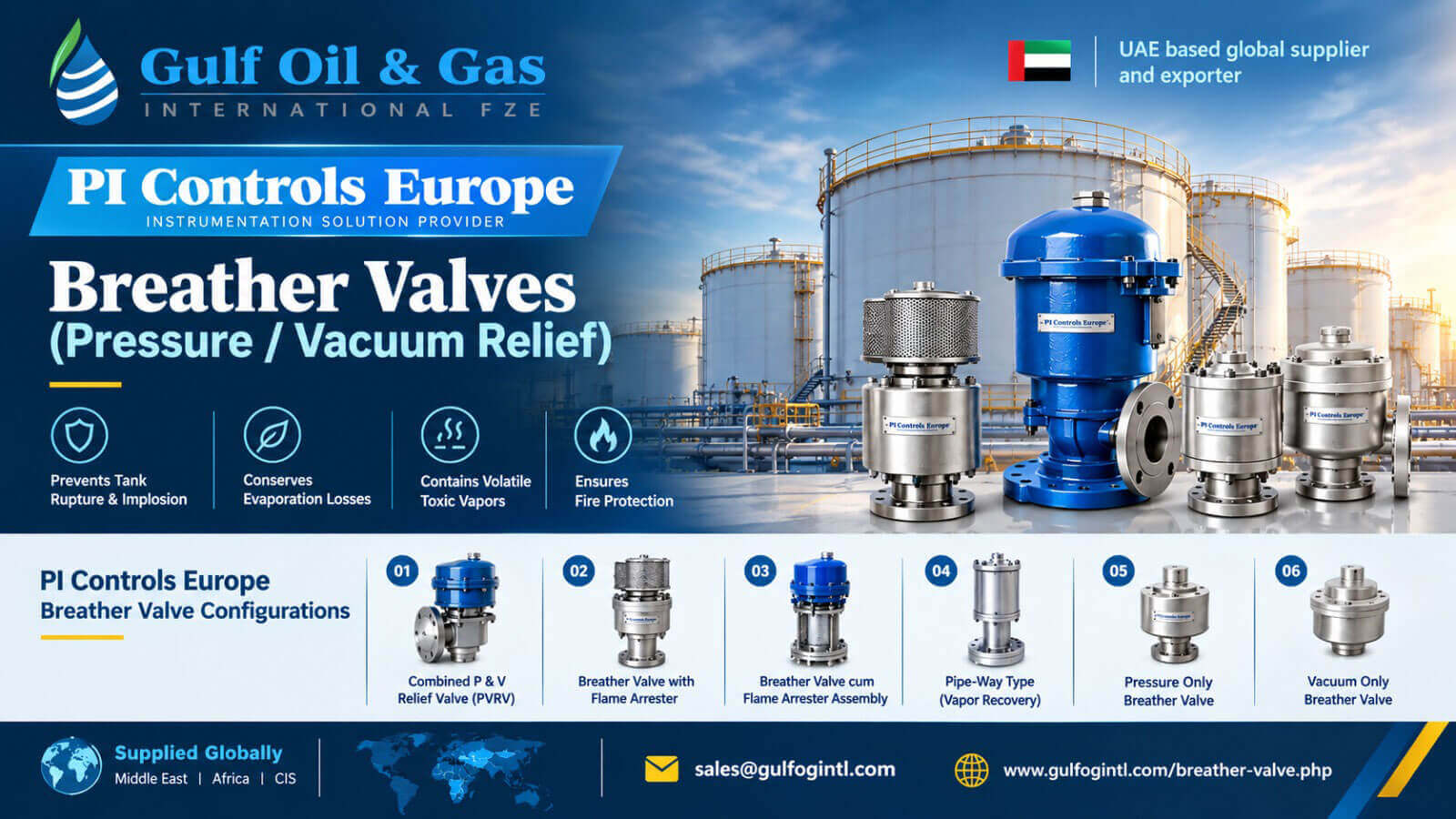
PI Controls Europe Breather Valve Configurations
Manufactured in multiple functional configurations to match open atmospheric venting, closed vapor recovery networks, and high-hazard flammable solvent storage.
01. Combined Pressure & Vacuum Relief Valve (PVRV)
Standard dual-action breather valve integrating pressure relief and vacuum breaking into a single compact tank fitting.
- Function: Automatic venting and conservation of evaporation losses
- Outlet Design: Weather hood for atmospheric discharge or flanged body
- Pallet Loading: Direct dead-weight or spring-assisted seating
- Applications: Crude oil, diesel, solvents, and non-flammable chemical storage
02. Breather Valve with In-Built Flame Arrester
Compact dual-function valve equipped with an integral crimped metal ribbon flame element inside the housing.
- Dual Protection: Facilitates tank breathing while providing vital flashback fire protection
- Space Saving: Integrated design eliminates separate flame arrester spool pieces
- Element Bank: Replaceable stainless steel corrugated matrix element
- Applications: Flammable solvent tanks, gasoline, ethanol, and light hydrocarbons
03. Breather Valve cum Flame Arrester Assembly
High-integrity arrangement positioning the breather valve directly on the discharge port of an independent flame arrester.
- Fire & Explosion Defense: Defends against external atmospheric ignition sources
- Full Bore Flow: Maximum venting capacity with minimal flow restriction
- Certified Quenching: Tested for deflagration quenching per ISO 16852 and API 2000
- Applications: Bulk refinery tank farms, chemical loading terminals, and alcohol distilleries
04. Pipe-Way Type Breather Valve (Vapor Recovery)
Closed-hood breather valve featuring flanged pipe connections on both its relief exhaust and vacuum suction ports.
- Closed Venting: Routes toxic or VOC vapors into closed vapor recovery systems (VRU)
- Nitrogen Ingestion: Connects vacuum port to inert nitrogen blanketing supply
- Flange Standard: Flanged ANSI B16.5 Class 150 RF (customizable upon request)
- Applications: Toxic chemical tanks, benzene, acids, and pressurized blanketing loops
05. Pressure Only Breather Valve
Dedicated overpressure relief device engineered exclusively for pressure venting operations on storage vessels.
- Dedicated Out-Breathing: Relieves positive tank pressure to atmosphere or piping
- Overpressure Safety: Protects against tank rupture and excessive boiling expansion
- Tight Reseating: Precision-lapped pallet prevents vapor leakage below set pressure
- Applications: Tanks with continuous inert gas padding or separate vacuum breakers
06. Vacuum Only Breather Valve
Specialized vacuum-breaking valve engineered exclusively for vacuum relief and atmospheric intake operations.
- Dedicated In-Breathing: Draws in ambient air or inert gas during negative pressure cycles
- Implosion Defense: Prevents vacuum-induced tank shell buckling and collapse
- Sensitive Calibration: Activates at minute negative differential pressures
- Applications: Vessels with separate emergency venting or thermal relief systems
Application Customization & Quality Testing Procedures
Gulf Oil & Gas International conducts comprehensive venting sizing, custom metallurgy configuration, and rigorous seat leakage testing for every unit.
Custom Sizing & Standards Compliance
- API 2000 (7th Edition): Venting atmospheric and low-pressure storage tanks
- ISO 28300: International petroleum, petrochemical, and natural gas venting
- API 2521: Pressure vent valves for atmospheric evaporation loss reduction
- API 520 / 521: Pressure-relieving and depressuring system integration
- N2 Blanketing Compatibility: Engineered to coordinate with blanket gas regulators
Certified Seat Leakage & Performance Testing
- Stringent Leakage Limit: Leakage rate certified below 0.03 Nm³/hr air at 90% set pressure
- API 2000 Verification: Tested for verified leak tightness at 75% of set point
- Flow Capacity Testing: Full open flow curve and air volume certification
- Hydrostatic & Pneumatic Checks: Shell casting integrity and air seat tightness
- Dimensional Inspection: Precision flange face and pallet alignment checks
Recommended Spares & Operational Support
- Moving Trim Spares: Pallets, PTFE diaphragms, guide stems, and springs
- Flame Element Banks: Factory replacement corrugated elements for flame arresters
- Dead Weights: Calibrated lead or stainless steel incremental disc weights
- Gaskets & Fasteners: Chemical-resistant PTFE and FKM replacement gaskets
- Field Retrofit Kits: Easy conversion between atmospheric and pipe-way configurations
Technical Specifications Matrix
Consolidated engineering specifications for PI Controls Europe Breather Valves.
| Specification Parameter | Standard Specification & Custom Range |
|---|---|
| Nominal Sizes | 1" (DN25) through 24" (DN600) and custom sizes as per customer request |
| Valve Configurations | Combined PVRV, PVRV with In-built Flame Arrester, Valve cum Flame Arrester, Pipe-Way, Pressure Only, Vacuum Only |
| Body Metallurgy (MOC) | Aluminium (LM6 / Cast), ASTM A216 Gr. WCB (Carbon Steel), SS 304, SS 316, Hastelloy, and custom alloys |
| Pallet & Trim Metallurgy | SS 304, SS 316, SS 316L, Hastelloy, with Teflon (PTFE / FEP) seating diaphragms |
| Loading Mechanisms | Dead-Weight Pallet Type, Spring-Loaded Mechanism, or Combined Hybrid |
| Flange Connections | ANSI B16.5 Class #150 RF, EN 1092-1, DIN, JIS, and custom drilled patterns |
| Set Pressure Range | From 2.5 mbar (25 mm W.C.) up to 1,000 mbar (custom calibrated per customer requirements) |
| Set Vacuum Range | From 2.5 mbar (25 mm W.C.) up to 500 mbar (custom calibrated per customer requirements) |
| Leakage Rate Performance | < 0.03 Nm³/hr air at 90% set pressure; bubble-tight reseating at 75% set point per API 2000 |
| Applicable Design Codes | API 2000, ISO 28300, API 2521, API 520 Part-I, API 521, ATEX Directive, CE, UL, ISO 9001:2015 |
Industries & Sectors Protected by PI Controls Europe
Essential tank safety devices deployed across oil refining, bulk chemicals, terminal logistics, and processing utilities.
Petroleum Refining & Bulk Terminals
Crude oil storage tanks, gasoline day tanks, diesel bunkering reservoirs, and marine loading terminal tank farms.
Chemical & Petrochemical Plants
Bulk solvent storage, benzene, toluene, xylene tanks, acid storage vessels, and intermediate product storage.
Pharmaceutical & Fine Chemicals
High-purity solvent tanks, ethanol storage, sterile pharmaceutical bulk vessels, and nitrogen-padded chemical reactors.
Food, Beverage & Distillery Plants
High-proof alcohol storage tanks, fermentation vessels, edible oil storage tanks, and industrial brewery bulk tanks.
Oil & Gas Upstream Facilities
Field production separator tanks, condensate stabilization vessels, produced water tanks, and slop oil collection systems.
Aviation Fuel Depots & Marine Terminals
Jet A-1 aviation fuel storage tanks, marine gas oil bunkering facilities, and harbor fuel distribution networks.
Pulp, Paper & Bio-Refineries
Turpentine storage tanks, tall oil handling vessels, biofuel fermentation tanks, and spent liquor storage.
Paint, Resin & Polymer Manufacturing
Monomer storage tanks, polymer emulsion vessels, industrial thinner holding tanks, and varnish processing facilities.
Water Treatment & Desalination
Sodium hypochlorite chemical storage, hydrochloric acid tanks, demineralized water break tanks, and caustic soda vessels.
Mining & Mineral Leaching Plants
Solvent extraction reagent tanks, sulfuric acid storage, fuel oil day tanks, and hydrometallurgical processing vessels.
Thermal & Combined Cycle Power Plants
Heavy fuel oil (HFO) storage, turbine lube oil reservoir tanks, emergency diesel generator fuel tanks, and demineralized water tanks.
Agricultural Chemicals & Fertilizers
Anhydrous ammonia holding vessels, liquid urea storage tanks, phosphoric acid tanks, and pesticide formulation vessels.
Critical Installation Applications & Engineering Roles
Ensuring atmospheric storage vessels remain compliant with international safety codes and environmental regulations.
Atmospheric Storage Tank Venting
- Fixed-Roof Cone & Dome Storage Tanks
- High-Flow Liquid Pump-In Overpressure Relief
- High-Flow Liquid Pump-Out Vacuum Protection
- Diurnal Solar Thermal Expansion & Night Contraction
- Minimizing Product Loss via Evaporation Barrier
Nitrogen Blanketing Coordination
- Interlocks with Nitrogen Blanketing Regulators
- Prevents Inadvertent Nitrogen Gas Loss
- Relieves Nitrogen Overpressure during Valve Failures
- Maintains Tank Inerting Blanket Integrity
- Pipe-Way Recovery of Displaced Nitrogen Gas
Environmental VOC & Fire Safety
- Exhaust Routing to Vapor Recovery Units (VRU)
- Vapor Destruction Flare Header Connection
- Integrated Deflagration Flame Flashback Stopping
- Toxic & Odorous Vapor Containment Systems
- Compliance with Clean Air & Emission Standards
Engineering Enquiry Guide & Specification Checklist
To configure and size the optimal PI Controls Europe Breather Valve, our technical team requires the following parameters:
Process Media & Tank Details
- Service Media: Chemical name, vapor molecular weight, specific gravity
- Tank Parameters: Volume (m³ / barrels), tank dimensions, roof type
- Tank Metallurgy: Tank shell material of construction
- Blanketing Status: N2 blanketing present (yes/no) and supply flow rate
Flow & Thermal Rates
- Pump-In Flow Rate: Maximum liquid filling displacement capacity
- Pump-Out Flow Rate: Maximum liquid discharge emptying capacity
- Design Conditions: Normal breathing vs. fire emergency venting
- Operating Limits: Maximum design pressure and design temperature
Calibration & Metallurgy
- Set Pressure: Required positive opening pressure (mbar / mm W.C.)
- Set Vacuum: Required negative opening vacuum (mbar / mm W.C.)
- Body Material: Aluminium, Carbon Steel, SS 316, or Hastelloy
- Internal Trim MOC: Stainless steel, PTFE, or exotic alloys
Territorial Supply Coverage: Middle East, Africa & CIS
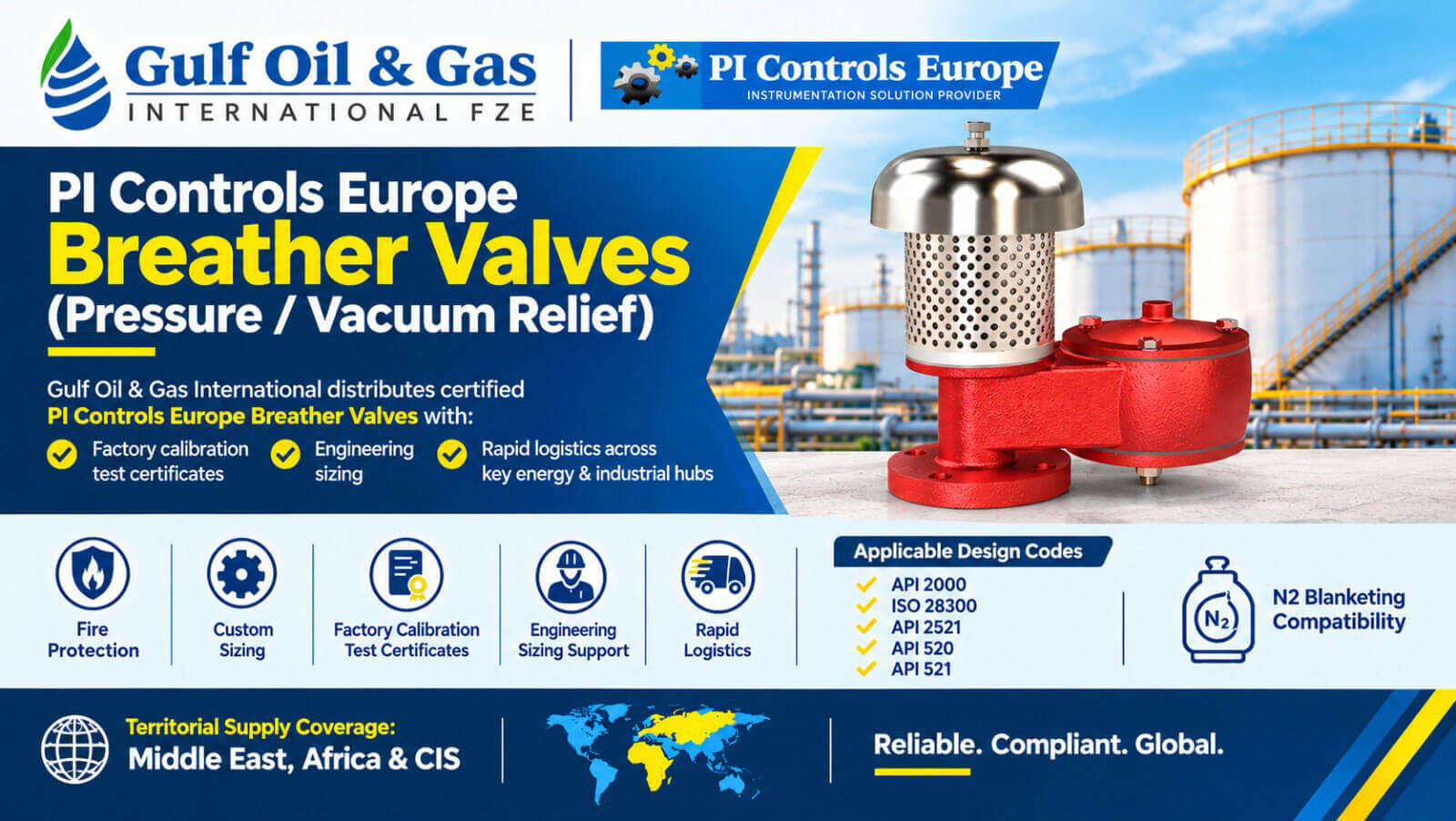
Gulf Oil & Gas International distributes certified PI Controls Europe Breather Valves with factory calibration test certificates, engineering sizing, and rapid logistics across key energy and industrial hubs:
🇦🇪 United Arab Emirates
Dubai (JAFZA, DIPC), Abu Dhabi (ICAD, Mussafah, Ruwais, Habshan), Sharjah (Hamriyah), Ras Al Khaimah, Fujairah Port.
🇸🇦 Saudi Arabia (KSA)
Riyadh Industrial Cities, Jubail Industrial City, Dammam 1st & 2nd, Yanbu, Ras Tanura, Rabigh, Jazan Economic City.
🇶🇦 Qatar & 🇰🇼 Kuwait
Doha Industrial Area, Ras Laffan Industrial City, Mesaieed, Kuwait City (Shuwaikh), Ahmadi Refinery Hub, Mina Abdulla.
🇴🇲 Oman & 🇧🇭 Bahrain
Muscat (Rusayl), Sohar Port, Salalah Free Zone, Duqm Port, Manama (Hidd Industrial Area), Sitra BAPCO Hub.
🇮🇶 Iraq
Basra (Khor Al Zubair Port), Erbil, Baghdad, Rumaila Oilfield, West Qurna, Baiji Industrial Hub.
🇪🇬 Egypt
Cairo (10th of Ramadan), Alexandria (Borg El Arab), Suez Canal Economic Zone, Port Said, Ain Sokhna, Damietta.
🇩🇿 Algeria
Hassi Messaoud, Skikda Petrochemical, Arzew Gas Terminal, Algiers Industrial Zone, Oran, Bethioua.
🇲🇦 Morocco
Casablanca, Tanger Med Port & Free Zone, Jorf Lasfar Industrial Complex, Safi Chemical Hub, Rabat, Kenitra.
🇹🇳 Tunisia & 🇱🇾 Libya
Tunis, Sfax, Bizerte Refinery Hub, Gabes Chemical Zone, Tripoli, Benghazi, Misrata Port, Ras Lanuf Terminal, Marsa El Brega.
🇳🇬 Nigeria
Lagos (Lekki FTZ, Apapa), Port Harcourt (Onne Port), Warri Refinery, Bonny Island LNG, Calabar Free Trade Zone, Kaduna.
🇬🇭 Ghana & 🇨🇮 Ivory Coast
Accra, Takoradi Port & Energy Hub, Tema Industrial Area, Abidjan Port & Refining Hub, San Pedro Port.
🇸🇳 Senegal & 🇲🇷 Mauritania
Dakar Port, Saint-Louis Offshore Gas Basin, Mbour, Nouakchott Port, Nouadhibou Mining Port.
🇦🇴 Angola
Luanda, Cabinda Offshore Terminal, Soyo LNG Hub, Lobito Port & Refinery Development.
🇬🇦 Gabon & 🇨🇬 Congo
Libreville, Port-Gentil Oil Terminal, Pointe-Noire Offshore Hub, Brazzaville Industrial Area.
🇬🇶 Equatorial Guinea & 🇨🇲 Cameroon
Malabo, Punta Europa LNG, Bata, Douala Industrial Port, Kribi Deep Sea Port, Limbe Refinery.
🇨🇩 DR Congo
Kinshasa, Lubumbashi Mining Center, Kolwezi Copperbelt, Matadi Port, Boma.
🇰🇪 Kenya & 🇺🇬 Uganda
Nairobi, Mombasa Port & Kipevu Oil Terminal, Lamu Port, Kisumu, Kampala, Hoima Lake Albert Energy Basin.
🇹🇿 Tanzania & 🇲🇿 Mozambique
Dar es Salaam Port, Mtwara Gas Hub, Tanga, Maputo Port, Afungi LNG Hub, Pemba Oil & Gas Port, Beira.
🇪🇹 Ethiopia & 🇷🇼 Rwanda
Addis Ababa, Dire Dawa Industrial Park, Hawassa Industrial Park, Kigali Special Economic Zone, Bugesera.
🇿🇦 South Africa
Johannesburg, Durban Port, Cape Town, Richards Bay Coal & Gas Terminal, Saldanha Bay, Secunda Sasol Complex, Sasolburg.
🇳🇦 Namibia & 🇧🇼 Botswana
Windhoek, Walvis Bay Port, Luderitz Energy Hub, Gaborone Industrial Area, Francistown, Jwaneng.
🇿🇲 Zambia & 🇿🇼 Zimbabwe
Lusaka, Kitwe Copperbelt, Ndola Refinery, Harare, Bulawayo Industrial Zone, Hwange Power Station.
🇰🇿 Kazakhstan & 🇦🇿 Azerbaijan
Aktau Port, Atyrau Caspian Hub, Tengiz Field, Kashagan Offshore, Baku Shipyard, Sangachal Terminal, Sumqayit.
🇺🇿 Uzbekistan & 🇹🇲 Turkmenistan
Tashkent, Bukhara Refinery, Navoiy Free Industrial Zone, Fergana, Ashgabat, Turkmenbashi Port & Refinery.
Frequently Asked Questions (FAQ)
Technical, operational, and engineering sizing details for PI Controls Europe Breather Valves.
Why is a Breather Valve essential for an atmospheric storage tank?
How does a breather valve conserve product and prevent emissions?
When should a Breather Valve with an In-built Flame Arrester be specified?
What is a Pipe-Way Breather Valve and where is it used?
What seat tightness standards do PI Controls Europe valves achieve?
How can custom breather valve sizing and quotations be requested?
Procure PI Controls Europe Breather Valves
Submit your storage tank parameters, pumping flow rates, solvent properties, and set pressures for API 2000 sizing verification and commercial quotation across Middle East, Africa, and CIS markets.