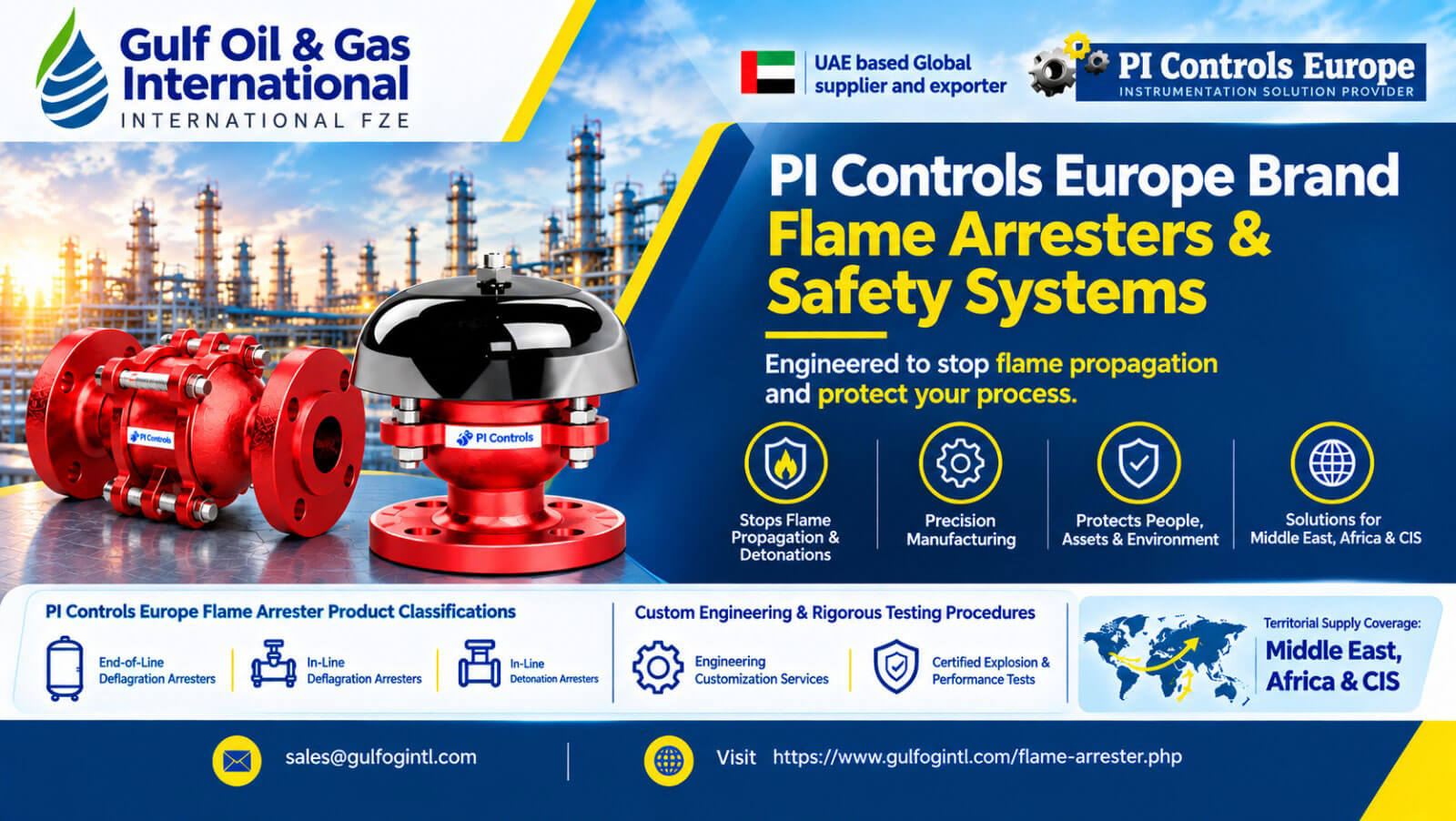
PI Controls Europe Flame Arresters & Safety Systems
Gulf Oil & Gas International delivers precision engineering, application-specific customization, and supply of genuine PI Controls Europe Flame Arresters. Engineered to stop the propagation of subsonic deflagrations and supersonic detonations in tanks, piping networks, and process vessels, our arresters protect personnel, plant equipment, and the environment across the Middle East, Africa, and CIS.
Maximum Experimental Safe Gap (MESG) & Quenching Mechanics
PI Controls Europe flame arresters operate by forcing an advancing flame front through a precision crimped corrugated metal ribbon matrix, transferring heat rapidly to the matrix walls until the flame temperature falls below the combustion threshold.
Heat Transfer & Extinction Mechanism
When a flammable gas mixture ignites, the flame enters narrow triangular passages within the corrugated matrix element.
- Narrow Channel Geometry: Narrow and elongated gaps amplify the cooling influence of the cold metal wall
- Thermal Dissipation: Extreme heat transfer drops the gas below its auto-ignition temperature
- Flashback Prevention: Extinguishes the flame front, stopping transmission into storage tanks
- Low Pressure Drop: Optimized matrix profile ensures high flow capacity and minimal resistance
MESG Gas Group Selection Criteria
Certified element gaps engineered to match the chemical reactivity and flame velocity of specific explosive mixtures.
- Gas Group IIA (MESG > 0.9 mm): Engineered for Propane, Methane, Butane, and natural gas vapors
- Gas Group IIB (MESG 0.5 – 0.9 mm): Engineered for Ethylene, Town Gas, and higher reactive hydrocarbons
- Gas Group IIC (MESG < 0.5 mm): Engineered for Hydrogen, Acetylene, and Carbon Disulfide
- Corrugated Matrix: Replaceable crimped ribbon element for easy cleaning and inspection
Explosion Combustion Classifications
Engineered for specific combustion velocity dynamics and piping installation run-up distances.
- Atmospheric Deflagration: Subsonic combustion occurring in open air on tank vent roofs
- In-Line Deflagration: Accelerated subsonic flame propagation within piping runs
- In-Line Detonation: Supersonic flame propagation characterized by destructive shock waves
- Short-Term & Endurance Burning: Certified for stabilized burning (3-5 min) and continuous burning
PI Controls Europe Flame Arrester Product Classifications
Precision manufactured by lost wax investment casting processes with removable corrugated elements for low maintenance and maximum safety.
End-of-Line Deflagration Arresters
Mounted directly on atmospheric storage tank vent nozzles or pressure/vacuum relief valve outlets to protect against atmospheric ignition sources.
- Casting Process: Precision lost wax investment cast body
- Size Availability: 1/2" (15 NB) to 24" (600 NB)
- Gas Groups: Certified for IIA, IIB, and IIC media
- Body Materials: ASTM A216 WCB, CF8, CF8M, CF3, CF3M, and Aluminium LM6
- Element Metallurgy: SS 304, SS 316, SS 316Ti, and Hastelloy C
- Weather Hood: Heavy-duty hood protects the element from rain and environmental debris
In-Line Deflagration Arresters
Bi-directional arresters installed in closed pipe systems near ignition sources where flame velocities remain within subsonic limits.
- Casting Process: Precision lost wax investment cast body
- Size Availability: 1/2" (15 NB) to 24" (600 NB)
- Gas Groups: Certified for IIA, IIB, and IIC media
- Body Materials: ASTM A216 WCB, CF8, CF8M, CF3, CF3M, and Aluminium LM6
- Element Metallurgy: SS 304, SS 316, SS 316Ti, and Hastelloy C
- Sensor Port: Standard integrated temperature monitoring ports provided
In-Line Detonation Arresters
Heavy-duty arresters built to withstand both low-pressure deflagrations and high-pressure supersonic detonations with severe shock waves in extensive piping networks.
- Casting Process: High-integrity investment cast construction
- Size Availability: 1/2" (15 NB) to 24" (600 NB)
- Gas Groups: Certified for IIA, IIB, and IIC media
- Shockwave Quenching: Heavy-duty element bank dampens supersonic pressure waves
- Element Metallurgy: SS 304, SS 316, SS 316Ti, and Hastelloy C
- End Connections: Flanged ANSI B16.5 Class 150, Class 300, and DIN / EN
Custom Engineering & Rigorous Testing Procedures
Gulf Oil & Gas International conducts custom application engineering, L/D run-up distance validation, and comprehensive quality assurance testing for every installation.
Engineering Customization Services
- Thermal & Vent Sizing: Sized per API 2000 (7th Edition) and ISO 16852 guidelines
- Fluoropolymer Coatings: Optional PTFE / PFA coated bodies for extreme chemical resistance
- Temperature Port Integration: Fitted with dual RTD ports for automated plant shutdown
- Removable Flame Elements: Corrugated matrix pulls out easily for simple maintenance
- Custom Flange Drilling: ANSI Class 150/300, EN 1092-1, and JIS standard drillings
Certified Explosion & Performance Tests
- Deflagration & Detonation Tests: Validated flame quenching under explosive limits
- Endurance Burn & Continuous Flame Tests: Certified against sustained fire fronts
- Flashback & Flame Transmission Tests: Zero flame passage across element matrix
- Flow Capacity & Delta-P Testing: Precise verification of air flow curves
- Hydrostatic & Pneumatic Tests: Shell pressure and seat air leakage verified
Maintenance & Operational Safety
- MESG Inspection: Element gaps must remain free from particulate clogging
- Solvent Washing: Corrugated ribbon elements clean easily using industrial solvents
- Operating Thresholds: Never exceed design temperature, pressure, or gas limits
- Spare Banks: Keep factory spare element banks in inventory to eliminate downtime
- Visual Alignment: Inspection of flame cages for mechanical denting or corrosion
Technical Specifications Matrix
Consolidated engineering specifications for PI Controls Europe Flame Arresters.
| Parameter | End-of-Line Deflagration | In-Line Deflagration | In-Line Detonation |
|---|---|---|---|
| Nominal Sizes | 1/2" (DN15) up to 24" (DN600) | 1/2" (DN15) up to 24" (DN600) | 1/2" (DN15) up to 24" (DN600) |
| Body Metallurgy | A216 WCB, CF8, CF8M, CF3, CF3M, LM6 Aluminium | A216 WCB, CF8, CF8M, CF3, CF3M, LM6 Aluminium | A216 WCB, CF8, CF8M, CF3, CF3M |
| Flame Element Material | SS 304, SS 316, SS 316Ti, Hastelloy C | SS 304, SS 316, SS 316Ti, Hastelloy C | SS 304, SS 316, SS 316Ti, Hastelloy C |
| Gas Groups (IEC / NEC) | IIA, IIB, IIC (Propane, Ethylene, Hydrogen) | IIA, IIB, IIC (Propane, Ethylene, Hydrogen) | IIA, IIB, IIC (Propane, Ethylene, Hydrogen) |
| Manufacturing Process | Lost wax investment casting | Lost wax investment casting | Heavy-duty investment cast body |
| End Connections | Flanged ANSI Class 150 RF, PN16, Weather Hood | Flanged ANSI Class 150 / 300, PN16 / PN40 | Flanged ANSI Class 150 / 300 RF, PN16 / PN40 |
| Design & Testing Codes | API 2000 (7th Ed), ISO 16852, ISO 9001 | API 2000 (7th Ed), ISO 16852, ISO 9001 | API 2000 (7th Ed), ISO 16852, ISO 9001 |
| Burning Classifications | Endurance Burning & Short-Term Burning | Short-Term Burning (3-5 Minutes) | Short-Term & Endurance Burning |
Industries & Sectors Protected by PI Controls Europe
Essential passive explosion barriers preventing catastrophic flash fires, equipment destruction, and production losses.
Oil & Gas Exploration & Production
Offshore production platforms, wellhead crude separation units, associated petroleum gas (APG) lines, and drilling mud degassing.
Petroleum Refining & Tank Farms
Bulk hydrocarbon liquid storage tanks, crude distillation column vents, fuel loading racks, and vapor recovery units (VRU).
Chemical & Petrochemical Processing
Exothermic reactor off-gas lines, solvent storage tanks, distillation columns, chemical blending tanks, and synthesis loops.
Pharmaceutical Manufacturing
Solvent recovery distillation vents, active pharmaceutical ingredient (API) reactor headers, and bulk chemical storage vessels.
Pulp & Paper Mills
Digester non-condensable gas (NCG) collection headers, black liquor recovery boilers, and turpentine condensation vent lines.
Landfills & Biogas Digesters
Anaerobic waste digester vents, methane gas blowers, biogas flaring manifolds, and landfill gas extraction pipelines.
Power Generation Plants
Hydrogen gas cooling loops on turbo-generators, fuel gas conditioning skids, fuel oil day tank vents, and synthetic gas lines.
Bulk Liquid Transport & Marine
Chemical parcel tankers, petroleum barges, inland liquid transport vessels, and tank truck vapor recovery manifolds.
Mining & Mineral Refining
Solvent extraction and electrowinning (SX/EW) plant vents, coal mine methane extraction piping, and autoclave off-gas circuits.
Paint, Resin & Synthetic Rubber
Monomer storage tanks, polymer emulsion reactors, paint mixing tanks, and industrial solvent evaporation vents.
Sewage & Wastewater Treatment
Sludge digestion tank vents, sewer gas containment systems, wet well blower lines, and bio-scrubber exhaust manifolds.
Aviation & Marine Fuel Depots
Aviation turbine fuel (ATF) storage tank vents, marine bunkering fuel terminals, and high-flow loading gantry manifolds.
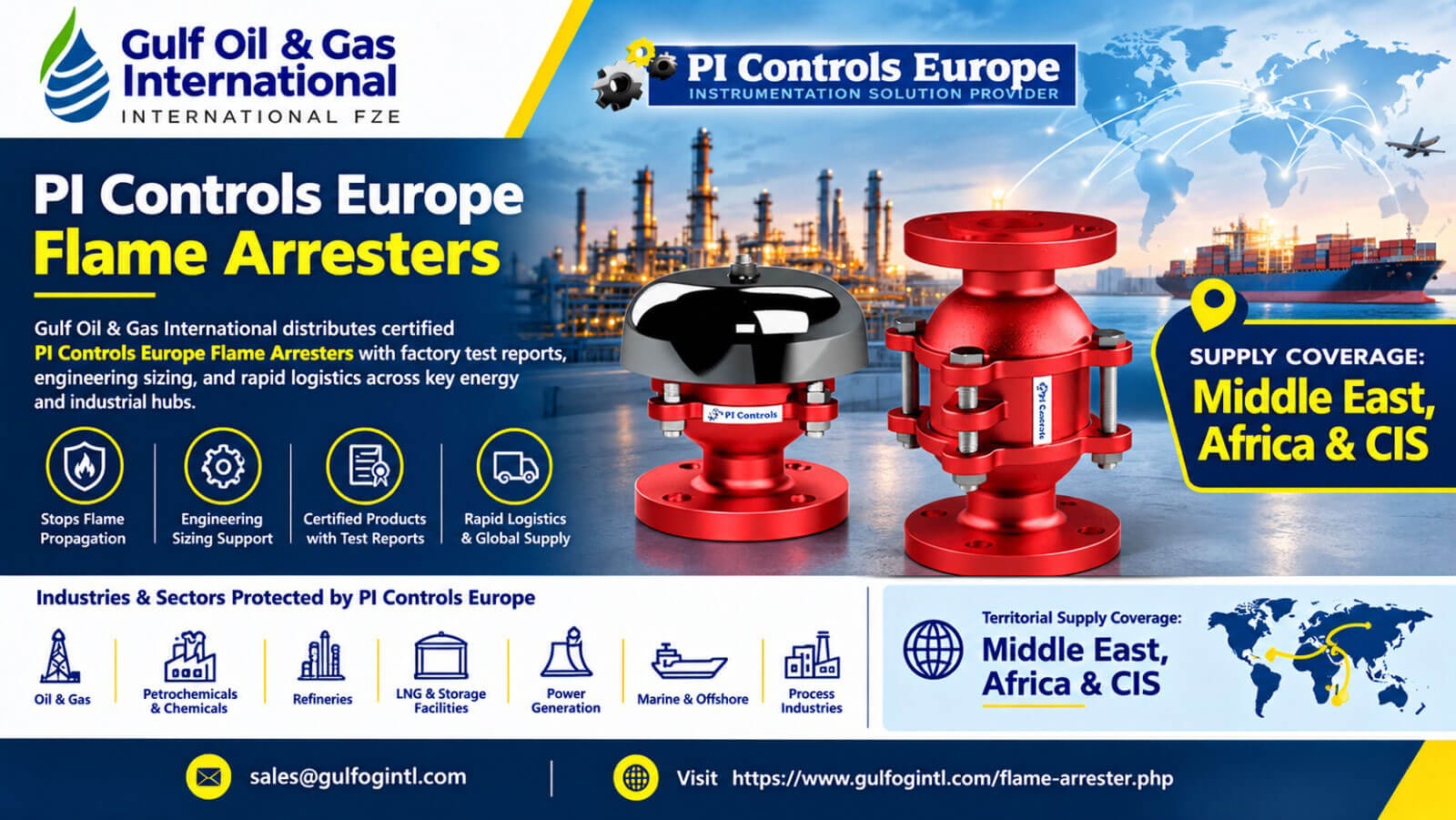
Territorial Engineering & Supply Coverage: Middle East, Africa & CIS
Gulf Oil & Gas International distributes certified PI Controls Europe Flame Arresters with factory test reports, engineering sizing, and rapid logistics across key energy and industrial hubs:
🇦🇪 United Arab Emirates
Dubai (JAFZA, DIPC), Abu Dhabi (ICAD, Mussafah, Ruwais, Habshan), Sharjah (Hamriyah), Ras Al Khaimah, Fujairah Port.
🇸🇦 Saudi Arabia (KSA)
Riyadh Industrial Cities, Jubail Industrial City, Dammam 1st & 2nd, Yanbu, Ras Tanura, Rabigh, Jazan Economic City.
🇶🇦 Qatar & 🇰🇼 Kuwait
Doha Industrial Area, Ras Laffan Industrial City, Mesaieed, Kuwait City (Shuwaikh), Ahmadi Refinery Hub, Mina Abdulla.
🇴🇲 Oman & 🇧🇭 Bahrain
Muscat (Rusayl), Sohar Port, Salalah Free Zone, Duqm Port, Manama (Hidd Industrial Area), Sitra BAPCO Hub.
🇮🇶 Iraq
Basra (Khor Al Zubair Port), Erbil, Baghdad, Rumaila Oilfield, West Qurna, Baiji Industrial Hub.
🇪🇬 Egypt
Cairo (10th of Ramadan), Alexandria (Borg El Arab), Suez Canal Economic Zone, Port Said, Ain Sokhna, Damietta.
🇩🇿 Algeria
Hassi Messaoud, Skikda Petrochemical, Arzew Gas Terminal, Algiers Industrial Zone, Oran, Bethioua.
🇲🇦 Morocco
Casablanca, Tanger Med Port & Free Zone, Jorf Lasfar Industrial Complex, Safi Chemical Hub, Rabat, Kenitra.
🇹🇳 Tunisia & 🇱🇾 Libya
Tunis, Sfax, Bizerte Refinery Hub, Gabes Chemical Zone, Tripoli, Benghazi, Misrata Port, Ras Lanuf Terminal, Marsa El Brega.
🇳🇬 Nigeria
Lagos (Lekki FTZ, Apapa), Port Harcourt (Onne Port), Warri Refinery, Bonny Island LNG, Calabar Free Trade Zone, Kaduna.
🇬🇭 Ghana & 🇨🇮 Ivory Coast
Accra, Takoradi Port & Energy Hub, Tema Industrial Area, Abidjan Port & Refining Hub, San Pedro Port.
🇸🇳 Senegal & 🇲🇷 Mauritania
Dakar Port, Saint-Louis Offshore Gas Basin, Mbour, Nouakchott Port, Nouadhibou Mining Port.
🇦🇴 Angola
Luanda, Cabinda Offshore Terminal, Soyo LNG Hub, Lobito Port & Refinery Development.
🇬🇦 Gabon & 🇨🇬 Congo
Libreville, Port-Gentil Oil Terminal, Pointe-Noire Offshore Hub, Brazzaville Industrial Area.
🇬🇶 Equatorial Guinea & 🇨🇲 Cameroon
Malabo, Punta Europa LNG, Bata, Douala Industrial Port, Kribi Deep Sea Port, Limbe Refinery.
🇨🇩 DR Congo
Kinshasa, Lubumbashi Mining Center, Kolwezi Copperbelt, Matadi Port, Boma.
🇰🇪 Kenya & 🇺🇬 Uganda
Nairobi, Mombasa Port & Kipevu Oil Terminal, Lamu Port, Kisumu, Kampala, Hoima Lake Albert Energy Basin.
🇹🇿 Tanzania & 🇲🇿 Mozambique
Dar es Salaam Port, Mtwara Gas Hub, Tanga, Maputo Port, Afungi LNG Hub, Pemba Oil & Gas Port, Beira.
🇪🇹 Ethiopia & 🇷🇼 Rwanda
Addis Ababa, Dire Dawa Industrial Park, Hawassa Industrial Park, Kigali Special Economic Zone, Bugesera.
🇿🇦 South Africa
Johannesburg, Durban Port, Cape Town, Richards Bay Coal & Gas Terminal, Saldanha Bay, Secunda Sasol Complex, Sasolburg.
🇳🇦 Namibia & 🇧🇼 Botswana
Windhoek, Walvis Bay Port, Luderitz Energy Hub, Gaborone Industrial Area, Francistown, Jwaneng.
🇿🇲 Zambia & 🇿🇼 Zimbabwe
Lusaka, Kitwe Copperbelt, Ndola Refinery, Harare, Bulawayo Industrial Zone, Hwange Power Station.
🇰🇿 Kazakhstan & 🇦🇿 Azerbaijan
Aktau Port, Atyrau Caspian Hub, Tengiz Field, Kashagan Offshore, Baku Shipyard, Sangachal Terminal, Sumqayit.
🇺🇿 Uzbekistan & 🇹🇲 Turkmenistan
Tashkent, Bukhara Refinery, Navoiy Free Industrial Zone, Fergana, Ashgabat, Turkmenbashi Port & Refinery.
Frequently Asked Questions (FAQ)
Technical, operational, and engineering sizing details for PI Controls Europe Flame Arresters.
What is Maximum Experimental Safe Gap (MESG) and why is it critical?
When should an in-line detonation arrester be selected over a deflagration arrester?
How does element clogging affect flame arrester performance?
What role do integrated temperature sensor ports play?
What materials of construction are recommended for corrosive tank vapors?
How can custom flame arrester sizing and quotations be requested?
Procure PI Controls Europe Flame Arresters
Submit your tank dimensions, flow requirements, vapor composition, and pipe run-up conditions for engineering sizing verification and commercial quotation across Middle East, Africa, and CIS markets.