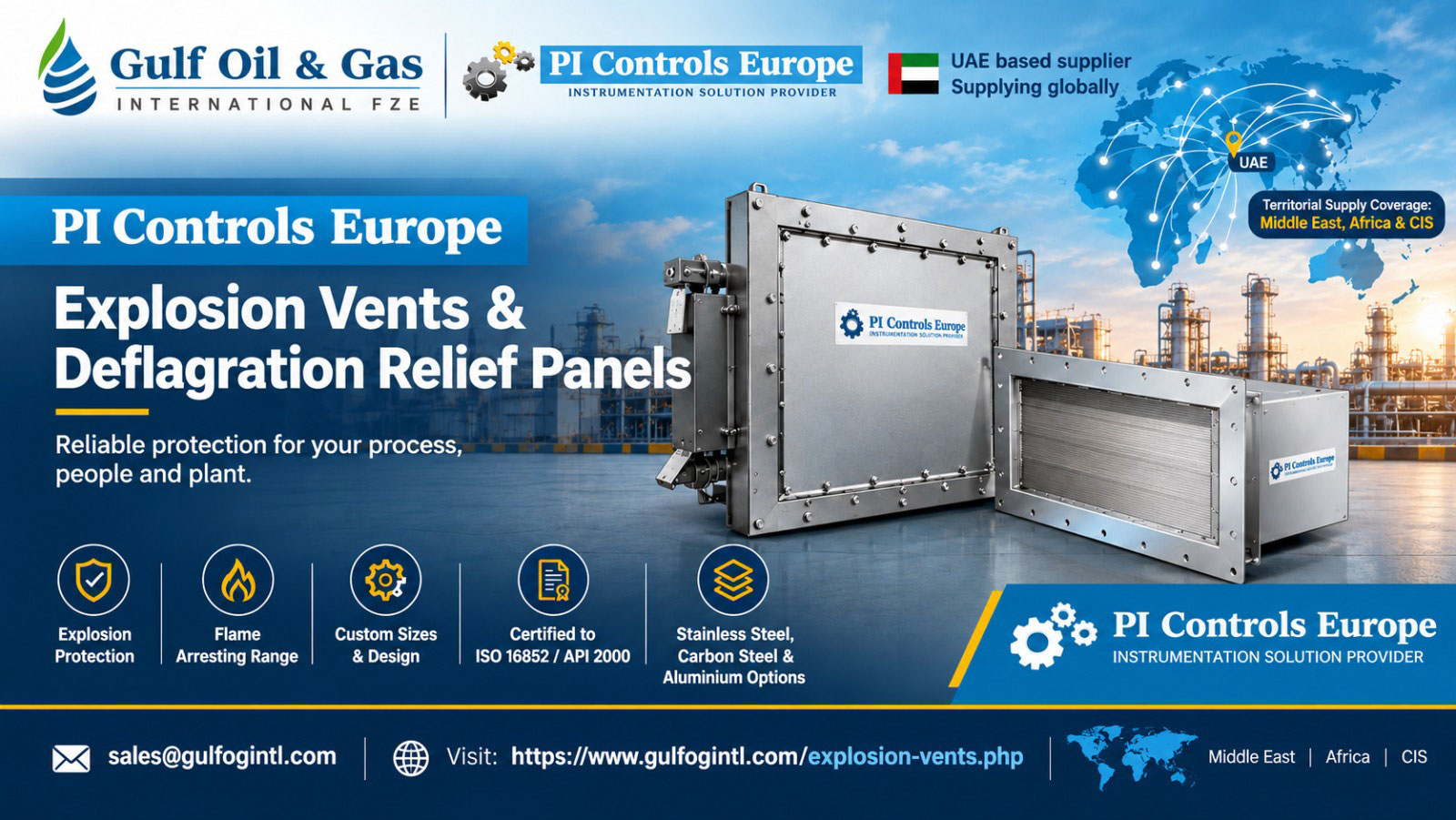
PI Controls Europe Explosion Vents & Deflagration Relief Panels
Gulf Oil & Gas International delivers precision engineering, application-specific customization, and supply of genuine PI Controls Europe Explosion Vents. Engineered to vent pressure before it reaches critical thresholds, our non-reclosing pressure-relief panels protect process enclosures, silos, baghouses, dust collectors, and pipelines from combustible dust, gas, and vapor deflagrations across the Middle East, Africa, and CIS.
Deflagration Venting Dynamics & Physical Mechanics
When combustible dust, flammable vapor, or gas ignites in an enclosed vessel, pressure escalates within milliseconds. PI Controls Europe explosion vents provide an instantaneous, full-bore opening to release expanding gases before internal pressures reach the ultimate strength limit of the equipment.
Millisecond Activation (Pstat)
Passive mechanical activation at a strictly calibrated static activation pressure (Pstat).
- Instantaneous Rupture: Opens in milliseconds without external electrical or pneumatic power
- Low Inertia Design: Lightweight engineered element ensures unrestricted acceleration
- Pressure Limitation: Keeps maximum reduced pressure (Pred) below vessel yield strength
- Structural Protection: Prevents catastrophic ruptures, structural tearing, and flying debris
High-Volume, Low-Pressure Events
Purpose-built for rapid gas volume displacement unlike standard overpressure relief valves.
- Massive Vent Area: Engineered for extreme exhaust area compared to conventional relief valves
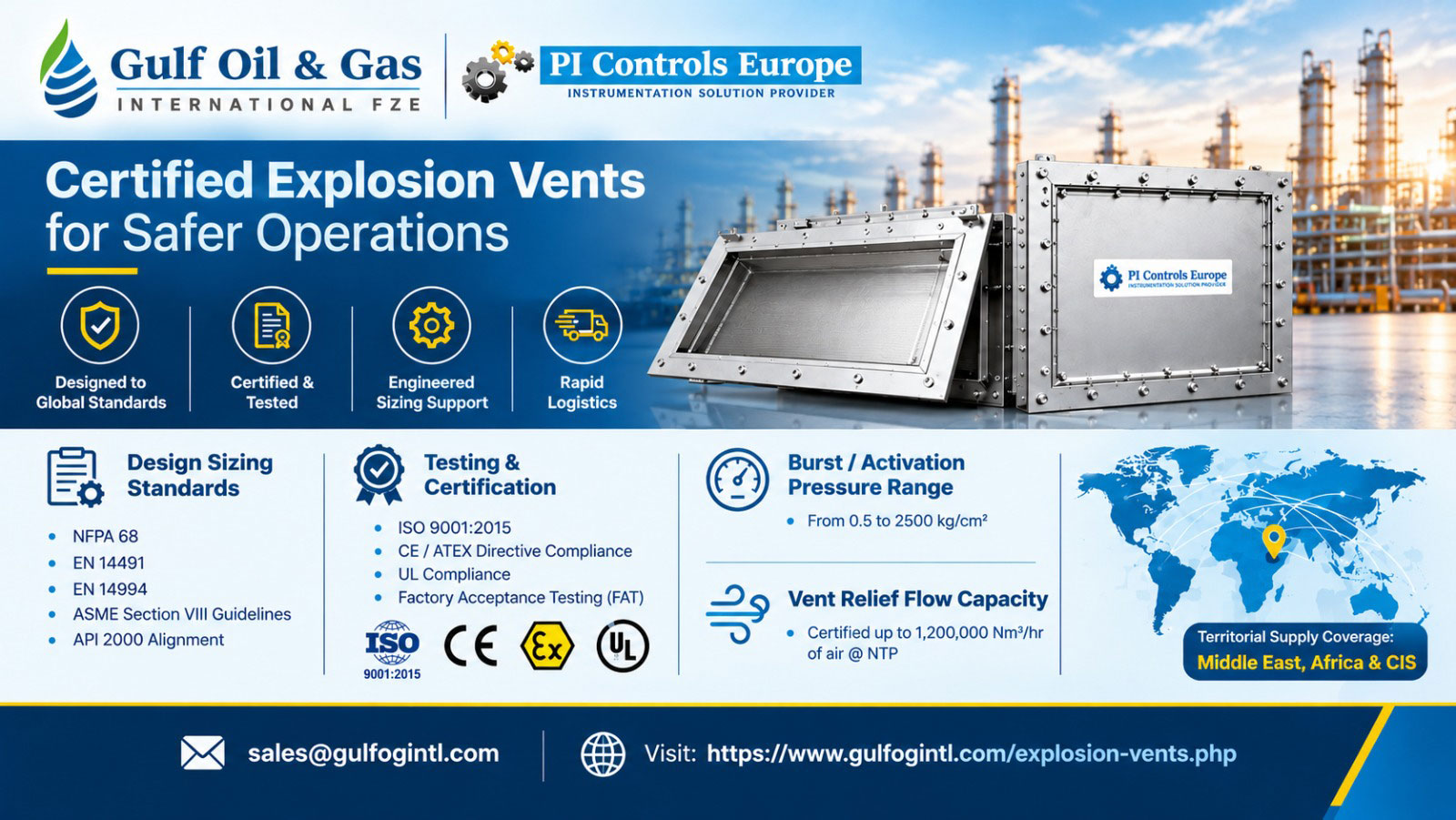
- High Flow Capacities: Certified venting flow rates up to 1,200,000 Nm³/hr of air at NTP
- Controlled Exhaust Path: Directs explosive fireballs and shock waves into designated safe zones
- Indoor Flameless Options: Compatible with flameless mesh quenchers to extinguish indoor flames
Process Integrity & Leak-Tight Sealing
Maintains absolute process sealing under continuous operating cycles, vibrations, and pulses.
- Bubble-Tight Boundary: Zero leakage under normal process pressures and vacuum cycles
- Fluoropolymer Seals: PTFE / FEP core membranes resist aggressive chemicals and moisture
- Vacuum Tolerance: Integral backplates provide mechanical resistance to continuous negative pressure
- Non-Fragmentation: Calibrated perimeter retainers prevent the panel from detaching into the exhaust stream
PI Controls Europe Explosion Vent Configurations
Manufactured in precision Buckling Type, Multi-Layer Composite Planar Type, and customized formats to suit diverse geometric and process requirements.
01. Buckling Type Explosion Vents
Engineered to activate through the controlled structural buckling of calibrated dome or plate ribs at precise burst set points.
- Mechanism: Controlled buckling under rapid dynamic overpressure
- High Cycling Durability: Resists pulsation and severe process pressure reversals
- Single-Piece Metallic: High mechanical integrity in abrasive bulk powder handling
- Common Geometries: Circular, rectangular, and square geometries up to 48" (1200 NB)
02. Composite / Planar Type Vents
Multi-layer flat or domed laminate construction designed for extreme chemical compatibility, low burst pressures, and superior sealing.
- Multi-Layer Structure: Slotted metallic top sheet, PTFE sealing membrane, and vacuum support
- Low Burst Calibration: Accurate activation at low static pressures (Pstat down to 0.5 kg/cm² or mbar)
- Sanitary & Food Grade: Smooth planar surfaces prevent powder accumulation and bacterial growth
- Corrosion Barrier: Complete resistance to organic acids, solvents, and humid fumes
03. Flameless & Application-Specific Designs
Engineered integration for indoor installations and high-temperature processing units requiring contained venting.
- Flameless Venting: Retains flame front and glowing dust while safely dissipating pressure
- High-Temperature Service: Alloy elements engineered for continuous operation up to 800°C
- Pneumatic Ducting: Formed to match curved cyclones, duct pipes, and cylindrical hoppers
- Explosion Isolation: Coordinates with active fast-acting chemical barriers and pinch valves
Component Construction & Assembly Anatomy
Every PI Controls Europe explosion vent assembly comprises five precision-matched structural components engineered for fail-safe opening.
1. Mounting Holder & Frame
Heavy-duty perimeter structural frame providing rigid clamp mounting to vessel cut-outs or duct flanges.
- Construction: Carbon steel painted, hot-dip galvanized, or stainless steel 304/316
- Drilling Standard: Standard ASME / DIN bolt patterns or custom pitch configurations
- Rigidity: Prevents edge distortion, ensuring uniform clamping torque across the seal
2. Explosion Vent Element & Backplate
The calibrated, pressure-sensitive core engineered to release instantaneously at predetermined Pstat.
- Vent Element: Precision slotted and score-cut stainless steel or exotic super-alloy sheet
- Vacuum Backplate: Multi-rib support preventing inward collapse during system vacuum
- Hinge Geometry: Integrated heavy-gauge hinge retains the vent panel upon burst
3. Perimeter Gaskets & Fasteners
High-grade resilient sealing barriers and calibrated clamping hardware.
- Gasket Materials: Closed-cell EPDM, Neoprene, pure PTFE, ceramic fiber for high temperatures
- Tight Sealing: Cushions the vent element, maintaining a process boundary
- Alloy Fasteners: High-tensile zinc-plated or stainless steel bolts engineered for structural hold
Technical Specifications Matrix
Consolidated engineering specifications for PI Controls Europe Explosion Vents.
| Specification Parameter | Standard Specification & Custom Range |
|---|---|
| Nominal Sizes | 6" to 48" [150 NB to 1200 NB] & above (Square, Rectangular, and Round formats) |
| Vent Relief Flow Capacity | Certified up to 1,200,000 Nm³/hr of air @ NTP |
| Burst / Activation Pressure Range | From 0.5 to 2500 kg/cm² (Custom calibrated in mbar for low-pressure dust collectors) |
| Materials of Construction (MOC) | SS 304, SS 316, SS 316L, PTFE, Hastelloy C, Tantalum, Nickel, Monel, Inconel |
| Operating Temperature Limits | Cryogenic ranges up to 800°C continuous service |
| Connection Types | Flanged (ASME B16.5, DIN EN), Welded Angle Frame, Bolted Clamp Bar, Screwed |
| Optional Accessories | PQ Tell-Tale Indicator, Intrinsically Safe Burst Sensor (B.D.I.), Flameless Quench Mesh, Weather Cover |
| Design Sizing Standards | NFPA 68, EN 14491, EN 14994, ASME Section VIII Guidelines, API 2000 Alignment |
| Testing & Certification | ISO 9001:2015, CE / ATEX Directive Compliance, UL Compliance, Factory Acceptance Testing (FAT) |
Industries & Sectors Protected by PI Controls Europe
Essential passive deflagration safety systems installed across bulk powder handling, energy production, and chemical processing complexes.
Grain, Feed & Milling Facilities
Grain storage silos, bucket elevators, flour mill cyclone separators, hammer mills, and grain dust baghouses.
Chemical & Petrochemical Processing
Fluidized bed dryers, polymer pelletizing hoppers, resin reaction vessels, spray drying towers, and cyclone bins.
Pharmaceutical & Fine Chemicals
Fluid bed granulators, tablet coating dryers, API micronizers, active substance centrifuges, and dust extraction filters.
Food, Dairy & Beverage Production
Powdered milk spray dryers, sugar storage silos, cocoa pulverizers, starch drying systems, and pneumatic conveying ducts.
Wood, Timber & Biomass Plants
Woodchip storage silos, sawdust collection baghouses, pelletizing hammer mills, biomass boiler fuel transfer chutes.
Power Generation & Coal Handling
Pulverized coal mills, coal dust extraction cyclones, boiler fuel bunkers, synthetic fuel gasifiers, and fly ash bins.
Mining, Cement & Metallurgy
Coal pulverizers in cement kilns, metallic dust collectors (Aluminium, Magnesium), smelting baghouses, and ball mills.
Pulp & Paper Manufacturing
Paper trimming extraction systems, dry fiber dust collection baghouses, chemical recovery cyclones, and waste shredders.
Cryogenic, LNG & LPG Systems
Vaporizer enclosures, cold-box overpressure relief panels, boil-off gas handling equipment, and compressor skids.
Refinery & Gas Processing Units
Sulfur recovery unit dust handling, solid catalyst hoppers, vacuum transfer bins, and flare knockout drum enclosures.
Paints, Pigments & Resins
Dry pigment blenders, powder coating grinding mills, electrostatic spray collection booths, and resin curing ovens.
Pneumatic & Mechanical Conveying
Dilute and dense phase pneumatic conveying pipelines, drag chain conveyors, screw feeder transitions, and diverter valves.
Critical Equipment Applications & Installation Locations
Targeted passive protection preventing equipment deformation, structural collapse, and secondary facility explosions.
Baghouses, Cyclones & Dust Collectors
- Vents combustible dust deflagrations initiated by electrostatic discharge
- Protects filter bags, tube sheets, and housing walls from internal shock waves
- Maintains structural integrity during continuous pulse-jet reverse cleaning cycles
- Low-mass panels pop open before pressure breaches duct connections
- Sized according to dust Kst and Pmax values per NFPA 68
Bulk Storage Silos & Feed Hoppers
- Protects tall agricultural and chemical storage silos from roof blow-off
- Relieves massive displacement pressure created during high-rate pneumatic filling
- Mitigates methane and volatile gas ignition in stored organic materials
- Flush-mount planar design prevents powder stagnation and moisture accumulation
- Weather-resistant outer frames resist driving rain, snow, and sandstorms
Process Dryers, Ovens & Fluid Beds
- Protects spray dryers, flash dryers, and fluid bed processors from thermal deflagrations
- Engineered with sanitary, FDA-compliant PTFE food-grade contact seals
- High-temperature construction withstands continuous hot air streams up to 800°C
- Thermal insulation blankets prevent process condensation and heat loss
- Integrates with electrical burst trip sensors to shut down heat sources instantly
Engineering Enquiry Guide & Specification Checklist
To calculate required vent area (Av) and configure the proper PI Controls Europe Explosion Vent, our engineering desk requires the following data:
1. Enclosure Geometry & Strength
- Equipment Type: Silo, baghouse, dust collector, cyclone, bucket elevator, or duct
- Vessel Volume: Total internal volume (m³ or ft³) and dimensions (L × W × H)
- Enclosure Strength (Pred): Maximum pressure the vessel can withstand without permanent deformation
- Installation Location: Outdoor vented or indoor (requiring flameless technology)
2. Combustible Material Characteristics
- Media Name: Dust, gas, vapor, or hybrid chemical mixture
- Explosion Index (Kst / Kg): Deflagration index (bar·m/s) per ASTM E1226
- Maximum Explosion Pressure (Pmax): Normalized maximum pressure (bar)
- Dust Hazard Class: St 1 (0–200), St 2 (201–300), or St 3 (>300 bar·m/s)
3. Process Conditions & Metallurgy
- Operating Pressure & Vacuum: Normal working pressure and maximum operating vacuum
- Operating Temperature: Continuous operating temperature and thermal peaks
- Required Activation (Pstat): Specified static burst pressure (mbar / PSI)
- Materials & Monitoring: SS 316L, Hastelloy, PTFE liner, Burst Sensor, Tell-Tale indicator
Territorial Supply Coverage: Middle East, Africa & CIS
Gulf Oil & Gas International distributes certified PI Controls Europe Explosion Vents with full calibration test certificates, engineering vent area sizing, and rapid logistics across key energy, mining, and manufacturing hubs:
🇦🇪 United Arab Emirates
Dubai (JAFZA, DIPC), Abu Dhabi (ICAD, Mussafah, Ruwais, Habshan), Sharjah (Hamriyah), Ras Al Khaimah, Fujairah Port.
🇸🇦 Saudi Arabia (KSA)
Riyadh Industrial Cities, Jubail Industrial City, Dammam 1st & 2nd, Yanbu, Ras Tanura, Rabigh, Jazan Economic City.
🇶🇦 Qatar & 🇰🇼 Kuwait
Doha Industrial Area, Ras Laffan Industrial City, Mesaieed, Kuwait City (Shuwaikh), Ahmadi Refinery Hub, Mina Abdulla.
🇴🇲 Oman & 🇧🇭 Bahrain
Muscat (Rusayl), Sohar Port, Salalah Free Zone, Duqm Port, Manama (Hidd Industrial Area), Sitra BAPCO Hub.
🇮🇶 Iraq
Basra (Khor Al Zubair Port), Erbil, Baghdad, Rumaila Oilfield, West Qurna, Baiji Industrial Hub.
🇪🇬 Egypt
Cairo (10th of Ramadan), Alexandria (Borg El Arab), Suez Canal Economic Zone, Port Said, Ain Sokhna, Damietta.
🇩🇿 Algeria
Hassi Messaoud, Skikda Petrochemical, Arzew Gas Terminal, Algiers Industrial Zone, Oran, Bethioua.
🇲🇦 Morocco
Casablanca, Tanger Med Port & Free Zone, Jorf Lasfar Industrial Complex, Safi Chemical Hub, Rabat, Kenitra.
🇹🇳 Tunisia & 🇱🇾 Libya
Tunis, Sfax, Bizerte Refinery Hub, Gabes Chemical Zone, Tripoli, Benghazi, Misrata Port, Ras Lanuf Terminal, Marsa El Brega.
🇳🇬 Nigeria
Lagos (Lekki FTZ, Apapa), Port Harcourt (Onne Port), Warri Refinery, Bonny Island LNG, Calabar Free Trade Zone, Kaduna.
🇬🇭 Ghana & 🇨🇮 Ivory Coast
Accra, Takoradi Port & Energy Hub, Tema Industrial Area, Abidjan Port & Refining Hub, San Pedro Port.
🇸🇳 Senegal & 🇲🇷 Mauritania
Dakar Port, Saint-Louis Offshore Gas Basin, Mbour, Nouakchott Port, Nouadhibou Mining Port.
🇦🇴 Angola
Luanda, Cabinda Offshore Terminal, Soyo LNG Hub, Lobito Port & Refinery Development.
🇬🇦 Gabon & 🇨🇬 Congo
Libreville, Port-Gentil Oil Terminal, Pointe-Noire Offshore Hub, Brazzaville Industrial Area.
🇬🇶 Equatorial Guinea & 🇨🇲 Cameroon
Malabo, Punta Europa LNG, Bata, Douala Industrial Port, Kribi Deep Sea Port, Limbe Refinery.
🇨🇩 DR Congo
Kinshasa, Lubumbashi Mining Center, Kolwezi Copperbelt, Matadi Port, Boma.
🇰🇪 Kenya & 🇺🇬 Uganda
Nairobi, Mombasa Port & Kipevu Oil Terminal, Lamu Port, Kisumu, Kampala, Hoima Lake Albert Energy Basin.
🇹🇿 Tanzania & 🇲🇿 Mozambique
Dar es Salaam Port, Mtwara Gas Hub, Tanga, Maputo Port, Afungi LNG Hub, Pemba Oil & Gas Port, Beira.
🇪🇹 Ethiopia & 🇷🇼 Rwanda
Addis Ababa, Dire Dawa Industrial Park, Hawassa Industrial Park, Kigali Special Economic Zone, Bugesera.
🇿🇦 South Africa
Johannesburg, Durban Port, Cape Town, Richards Bay Coal & Gas Terminal, Saldanha Bay, Secunda Sasol Complex, Sasolburg.
🇳🇦 Namibia & 🇧🇼 Botswana
Windhoek, Walvis Bay Port, Luderitz Energy Hub, Gaborone Industrial Area, Francistown, Jwaneng.
🇿🇲 Zambia & 🇿🇼 Zimbabwe
Lusaka, Kitwe Copperbelt, Ndola Refinery, Harare, Bulawayo Industrial Zone, Hwange Power Station.
🇰🇿 Kazakhstan & 🇦🇿 Azerbaijan
Aktau Port, Atyrau Caspian Hub, Tengiz Field, Kashagan Offshore, Baku Shipyard, Sangachal Terminal, Sumqayit.
🇺🇿 Uzbekistan & 🇹🇲 Turkmenistan
Tashkent, Bukhara Refinery, Navoiy Free Industrial Zone, Fergana, Ashgabat, Turkmenbashi Port & Refinery.
Frequently Asked Questions (FAQ)
Technical, operational, and engineering sizing details for PI Controls Europe Explosion Vents.
What is an Explosion Vent and how does it prevent equipment destruction?
What is the difference between an Explosion Vent and a Rupture Disc?
How does the Composite / Planar type explosion vent differ from the Buckling type?
Can PI Controls Europe explosion vents be installed on indoor equipment?
What monitoring accessories are available for explosion vents?
How do I initiate a custom vent sizing request with Gulf Oil & Gas International?
Procure PI Controls Europe Explosion Vents
Submit your silo dimensions, dust collector parameters, Kst values, and process operating conditions for NFPA 68 vent area calculation, custom sizing verification, and commercial quotation across Middle East, Africa, and CIS markets.